
Understanding the Utah Divorce Timeline: What Happens From Filing to Final Decree?
By Jeff D. Rifleman, Rifleman Law & Mediation
Divorce is not usually a single event. It is a legal process with stages, deadlines, disclosures, negotiations, and court requirements. For many people, the hardest part is not only the emotional strain of the divorce itself, but the uncertainty of not knowing what happens next.
At Rifleman Law & Mediation, we help clients understand the practical steps of a Utah divorce from the first consultation through final decree. Whether you are looking for a Lehi divorce lawyer, need help with divorce in Saratoga Springs, or are facing a contested custody case in Utah County, understanding the timeline can help you make better decisions.
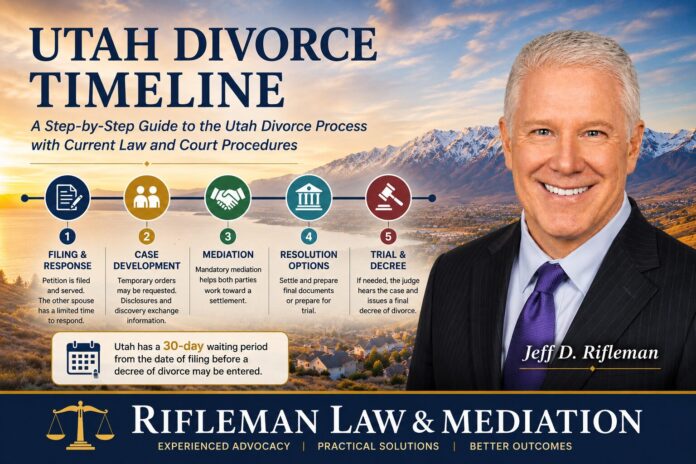
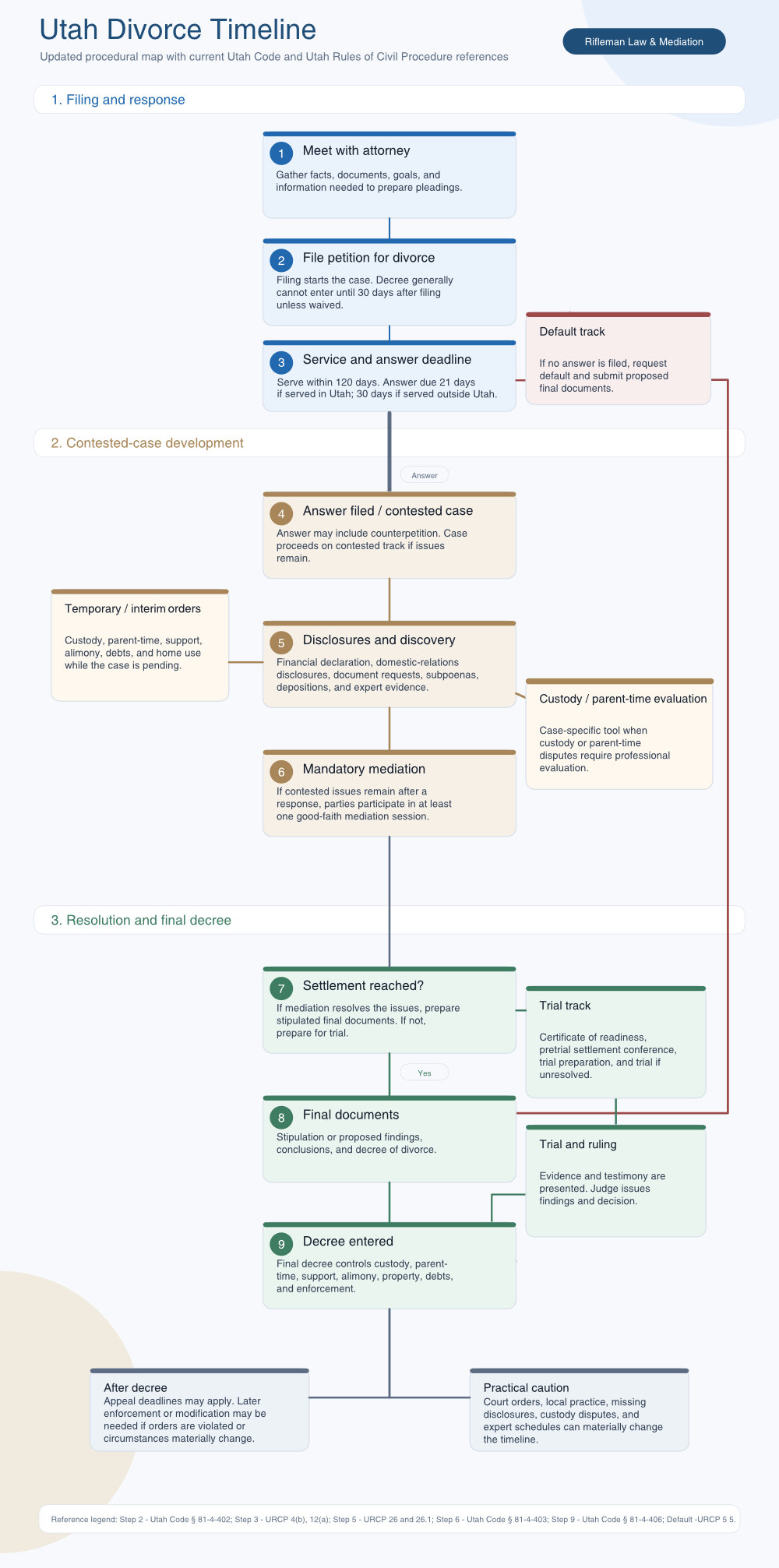
Every divorce is different. Some cases settle quickly. Others involve temporary orders, discovery, custody disputes, mediation, pretrial conferences, and trial. The following timeline explains the general path a Utah divorce may follow.
The Divorce Process Begins Before the Petition Is Filed
Most divorce cases begin before anything is filed with the court. The first step is usually meeting with an attorney, identifying the issues, and gathering the information needed to prepare the initial pleadings.
This early stage matters. A divorce petition should not be drafted casually. It may raise issues involving child custody, parent-time, child support, alimony, retirement accounts, real estate, debt allocation, business interests, and attorney fees. The way the case begins can affect the way the case develops.
If children are involved, the attorney will need information about the existing parenting arrangement, school schedules, communication problems, parent-time concerns, and whether either parent may seek temporary custody orders. If financial issues are contested, the attorney will need income information, tax returns, bank records, mortgage information, retirement account balances, and debt documentation.
Filing the Petition for Divorce
The formal divorce process begins when one spouse files a petition for divorce. The spouse who files is called the Petitioner. The other spouse is called the Respondent.
The petition asks the court to grant the divorce and resolve the issues between the parties. In a Utah divorce, those issues may include child custody, parent-time, child support, alimony, property division, debt division, and attorney fees.
For clients in northern Utah County, this is often where the case begins with a consultation about strategy, filing options, and whether immediate temporary orders may be necessary. Clients searching for a divorce attorney in Lehi often need help determining whether to file immediately, attempt settlement first, or prepare for contested litigation.
Service of Process
After the petition is filed, the Respondent must be properly served. Service of process is the formal delivery of the divorce papers. This is not merely a courtesy copy. It is the legal notice that starts the Respondent’s deadline to answer.
Under the Utah Rules of Civil Procedure, a respondent generally has 21 days to answer if served inside Utah and 30 days if served outside Utah. If the Respondent does not answer on time, the Petitioner may seek default.
Why Service Matters
Service is important because a divorce case cannot move forward properly unless the Respondent has legal notice. It also creates the deadline for the Respondent to participate in the case. Ignoring divorce papers does not stop the divorce. In many cases, it simply allows the filing party to move toward default judgment.
Default or Answer
After service, the case usually moves in one of two directions. Either the Respondent files an answer, or the Respondent fails to answer and the Petitioner seeks default.
If No Answer Is Filed
If the Respondent does not file an answer within the required time, the Petitioner may request default. A default does not mean every request is automatically granted without review. The requested final documents still need to be consistent with the petition, and the court must still be satisfied that the proposed decree is proper.
Utah currently requires a waiting period before a divorce decree may be entered. The current waiting period is generally 30 days from the date the petition is filed unless the court waives the waiting period based on extraordinary circumstances.
If an Answer Is Filed
If the Respondent files an answer, the case becomes contested unless the parties are already in agreement on all terms. The answer may admit some allegations, deny others, and raise additional requests. The Respondent may also file a counterpetition asking the court for different relief.
Once an answer is filed, the case generally proceeds into the litigation track, which may include an attorney planning meeting, disclosures, discovery, temporary orders, mediation, settlement conferences, and trial preparation.
Temporary Orders
Temporary orders can be one of the most important parts of a Utah divorce case. These orders govern the parties while the divorce is pending. They may address who remains in the home, who pays which bills, temporary alimony, temporary child support, temporary custody, and temporary parent-time.
Temporary orders can have a practical effect far beyond the temporary period. Although temporary orders are not final orders, they often establish routines and expectations that influence settlement negotiations and trial positions.
For parents, temporary custody and parent-time orders may be especially important. A parent involved in a contested custody case should carefully consider whether to seek temporary relief early in the case. More information about custody issues is available on our Lehi child custody lawyer page.
Initial Disclosures and Financial Information
After the case is underway, the parties must exchange required information. This typically includes financial information, documents supporting claims, and information relevant to custody, support, property division, and debt division.
In many divorces, financial disclosures become a central issue. A party may not know the full extent of the marital estate. One spouse may have controlled the finances. A party may be self-employed. There may be questions about income, business expenses, hidden accounts, cryptocurrency, retirement funds, or the value of real property.
In cases involving support, the parties generally need to analyze income, employment, expenses, and the needs of the children. Clients dealing with child support issues may find additional information on our Lehi child support attorney page.
Discovery
Discovery is the formal process of gathering evidence. It may include written discovery, requests for documents, subpoenas, depositions, business records, bank records, retirement account statements, tax returns, and other relevant information.
Discovery is often where the real facts of the case become clear. In some cases, the parties initially believe the divorce is simple, only to discover that income, debt, property, or custody issues are more complicated than expected.
Discovery is especially important when one party is not voluntarily disclosing information. It is also important when the parties disagree about income, alimony, valuation, dissipation of assets, or whether a claimed debt is marital or separate.
Custody and Parent-Time Evaluations
When custody or parent-time is seriously disputed, the parties may request additional professional involvement. Depending on the case, this may include a custody evaluation, parent-time evaluation, therapist involvement, guardian ad litem, or other professional assessment.
Custody litigation is not only about what each parent wants. The court must consider the best interests of the child. That may require evidence regarding the child’s needs, each parent’s involvement, communication between the parents, school issues, stability, safety concerns, and each parent’s ability to support the child’s relationship with the other parent.
These issues can become highly fact-specific. Parents should not assume that a custody case will be resolved by general arguments. Courts need evidence, documentation, and a workable parenting plan.
Mandatory Mediation
In Utah, contested divorce cases generally require mediation before trial. Mediation is a structured settlement process with a neutral mediator. The mediator does not decide the case. Instead, the mediator helps the parties evaluate risk, exchange proposals, and attempt to reach a resolution.
Mediation can address every major issue in the divorce, including custody, parent-time, child support, alimony, real property, retirement division, personal property, debt, and attorney fees.
For many families, mediation is the most efficient way to resolve the case. It allows the parties to maintain more control over the outcome and avoid the cost, delay, and uncertainty of trial. More information is available on our Lehi divorce mediation lawyer page.
What Happens If Mediation Works?
If mediation results in settlement, the parties usually move toward preparing final documents. Those documents may include a stipulation, findings of fact and conclusions of law, and a proposed decree of divorce.
Settlement does not mean the case is finished the moment the parties shake hands. The agreement still needs to be reduced to enforceable written terms and submitted to the court for approval.
What Happens If Mediation Fails?
If mediation does not resolve the case, the matter continues toward trial. The parties may still settle later, but the case must be prepared as though trial will occur.
Divorce Education and Orientation Requirements
When the parties have minor children, Utah requires divorce-related education before the court will enter final orders. These requirements are intended to help parents understand the divorce process, the impact of divorce on children, and the importance of reducing conflict.
Failure to complete required classes can delay finalization of the divorce. Parents should not leave these requirements until the last minute.
Certificate of Readiness and Trial Setting
If the case does not settle, the parties eventually move toward trial setting. This generally occurs after the case has progressed through disclosures, discovery, mediation, and necessary pretrial preparation.
At this stage, the parties identify the unresolved issues and prepare to present evidence. Trial preparation may include exhibit lists, witness lists, subpoenas, financial summaries, custody evidence, proposed findings, and legal argument.
Divorce trials require preparation. A party who waits until the final weeks before trial to organize documents, witnesses, and evidence is usually at a disadvantage.
Pretrial Settlement Conference
Before trial, the court may require a pretrial settlement conference. In many Utah divorce cases, the parties first attend a settlement conference with a commissioner. If the case still does not settle, the case may be certified to a judge and proceed toward a judicial pretrial conference and trial.
Pretrial settlement conferences are not meaningless formalities. By this stage, the parties usually understand the evidence better. The risks are clearer. Attorney fees have increased. Trial is closer. As a result, cases that did not settle at mediation sometimes settle during pretrial proceedings.
Trial
If settlement fails, the case proceeds to trial. At trial, each party presents evidence and testimony. The judge decides the disputed issues.
Trial may involve testimony from the parties, lay witnesses, experts, custody evaluators, accountants, appraisers, or other professionals. The court may receive exhibits such as financial records, school records, communication records, photographs, text messages, medical records, calendars, and other relevant evidence.
Trial is where preparation matters. The judge does not decide the case based on emotion alone. The court decides based on admissible evidence, credibility, statutory factors, and the best interests of the children where custody is disputed.
Findings, Conclusions, and Decree of Divorce
After settlement or trial, final documents must be prepared and entered. These typically include findings of fact, conclusions of law, and the decree of divorce.
The decree is the final controlling order. It addresses the rights and obligations of the parties going forward. It may include provisions regarding custody, parent-time, child support, alimony, property division, debt allocation, retirement division, tax issues, insurance, communication, transportation, and enforcement.
Once the decree is entered, both parties are bound by its terms.
Enforcement and Modification
For many families, the divorce decree is not the end of the legal relationship. Orders sometimes need to be enforced. Circumstances sometimes change. Children grow older. Parents move. Income changes. Parent-time schedules stop working. Support may need to be recalculated.
When a party violates the decree, enforcement may be necessary. This may involve unpaid child support, denied parent-time, refusal to transfer property, failure to pay debts, or failure to comply with custody provisions. Additional information is available on our Lehi divorce enforcement lawyer page.
When circumstances materially and substantially change, modification may be appropriate. This may involve custody modification, parent-time modification, child support modification, or alimony modification. More information is available on our Lehi divorce modification lawyer page.
How Long Does a Utah Divorce Take?
The timeline depends on the case. An uncontested divorce may be completed relatively quickly if the parties agree, required documents are prepared correctly, and statutory waiting periods and education requirements are satisfied.
A contested divorce may take significantly longer. Cases involving custody disputes, business ownership, disputed income, high-conflict communication, hidden assets, or contested alimony may require months of litigation before settlement or trial.
The most common factors that affect the timeline include:
- whether the Respondent files an answer;
- whether temporary orders are needed;
- whether the parties exchange complete financial disclosures;
- whether custody or parent-time is disputed;
- whether mediation is successful;
- whether expert evaluations are needed;
- whether the case proceeds to trial; and
- how quickly the court can schedule hearings and trial dates.
Divorce Timeline Issues in Lehi and Utah County
Divorce cases in Lehi, Saratoga Springs, American Fork, Eagle Mountain, Pleasant Grove, Orem, and Provo frequently involve young families, growing households, real estate, commuter employment, blended families, and contested parenting schedules.
For clients in Lehi, the divorce timeline often turns on whether the case involves contested custody, support, or property issues. A simple agreed divorce may move efficiently. A disputed custody case may require temporary orders, mediation, discovery, and substantial preparation.
Clients in nearby communities may also review our pages for American Fork divorce and custody cases, Eagle Mountain divorce and custody cases, Pleasant Grove divorce and custody cases, Orem divorce and custody cases, and Provo divorce and custody cases.
Strategic Preparation Matters
The divorce timeline is not just a checklist. Each stage affects the next. Poor preparation at the beginning can create problems later. Incomplete disclosures can delay mediation. Weak temporary orders can affect leverage. Lack of documentation can harm settlement and trial strategy.
A disciplined divorce strategy considers not only what must be filed today, but what evidence may be needed six months from now if the case does not settle.
Important Questions to Ask Early
- Will custody or parent-time be disputed?
- Is temporary support needed?
- Is one spouse withholding financial information?
- Are there retirement accounts, business interests, or real estate to divide?
- Is alimony likely to be requested?
- Are there concerns about enforcement after the decree?
- Is mediation likely to be productive?
- What evidence needs to be preserved now?
For cases involving alimony, clients may also review our Lehi alimony lawyer page.
Speak With Rifleman Law & Mediation About Your Divorce Timeline
If you are considering divorce, have been served with divorce papers, or are already involved in a contested case, understanding the timeline is only the beginning. The more important question is how to navigate each stage effectively.
Rifleman Law & Mediation assists clients with divorce, custody, parent-time, child support, alimony, mediation, enforcement, and modification cases throughout Lehi, Saratoga Springs, American Fork, Eagle Mountain, Pleasant Grove, Orem, Provo, and surrounding Utah communities.
To discuss your case, contact Rifleman Law & Mediation and schedule a free consultation.
