

Lindon Divorce Attorney
Protecting Families, Businesses, and Long-Term Financial Security
Lindon is a smaller, established community within Utah County, characterized by long-term home ownership, family-run businesses, professional careers, and generational roots. Divorce in Lindon often involves more than dissolving a marriage. It requires untangling years of financial growth, business development, retirement accumulation, and shared parental responsibility.
In many Lindon divorce cases, the issues are not impulsive or temporary. They are structural. They involve ownership interests, real property equity, business valuation, and long-standing parenting patterns. A divorce must be handled with careful documentation, deliberate strategy, and courtroom readiness.
Jeff D. Rifleman of Rifleman Law & Mediation represents individuals in Lindon who require structured advocacy in divorce (contested or uncontested), child custody, and financial disputes. Every case is prepared with the expectation that it must withstand judicial scrutiny. As a Lindon divorce lawyer, Jeff D. Rifleman focuses on business valuation, enforceable drafting, and structured asset division designed to protect long-term financial stability.
Need a Divorce Lawyer in Lindon?
Book your FREE, no obligation, confidential consultation.FREE CONSULTATION
Need a Divorce Lawyer in Lindon?
Book your FREE, no obligation, confidential consultation.Divorce Representation in Lindon, Utah
Comprehensive Financial Analysis and Asset Protection
Divorce in Lindon frequently involves established financial portfolios. Many households include:
- Long-term home equity
- Privately held business interests
- Professional practices
- Retirement and pension accounts
- Investment portfolios
- Deferred compensation
Utah law requires equitable division of marital property. That does not mean equal—it means fair based on the circumstances. Determining fairness requires clear identification of marital versus separate assets, proper valuation of businesses, and tracing of premarital contributions.
In Lindon divorce cases involving business ownership, valuation becomes central. Courts may evaluate goodwill, revenue history, operational expenses, and future earning potential. Accurate financial records are critical.
When real property is involved, structured buyouts or sale provisions must be carefully drafted to prevent ongoing financial entanglement. Divorce decrees should eliminate ambiguity—not create future disputes.
Temporary orders may also shape financial stability during litigation. Early strategic planning helps preserve credit, manage debt, and protect assets.
Lindon Child Custody Lawyer
Structured Parenting Plans for Long-Term Stability
Child Custody decisions in Lindon divorce cases often involve parents who have shared years of consistent involvement in education, extracurricular activities, and community life. Courts focus on preserving stability and minimizing disruption.
Utah courts determine child custody and parent time based on the best interests of the children. Judges evaluate:
- Historical caregiving roles
- Consistency and reliability
- Emotional support
- Ability to cooperate
- Stability of housing and schooling
In Lindon child custody disputes, courts expect credible, documented evidence of involvement. Assertions are insufficient without proof.
Jeff D. Rifleman assists Lindon parents in:
- Establishing joint legal custody protections
- Crafting detailed and enforceable parent-time schedules
- Addressing relocation concerns
- Litigating child custody evaluations
- Seeking or opposing child custody modifications
- Enforcing parent-time rights
Well-drafted parenting plans reduce future conflict. Specificity prevents recurring disputes.
Child Support in Lindon Divorce Cases
Accurate Income Assessment and Financial Fairness
Lindon households often include professional income, self-employment revenue, or business ownership compensation. Child support must reflect accurate and reliable income figures.
Under Utah statutory guidelines, support calculations are based primarily on income and child custody structure. However, disputes frequently arise over:
- Business income reporting
- Salary versus distributions
- Bonus structures
- Overtime
- Health insurance allocation
- Childcare costs
Courts examine tax returns, financial statements, and earning capacity. Income may be imputed when underemployment is voluntary.
Clear financial affidavits and credible documentation are critical in both establishing and challenging child support.
Division of Property and Debts
Preserving Equity and Preventing Future Liability
Property division in Lindon divorce cases often centers on substantial equity and long-term asset growth.
Key issues frequently include:
- Valuation of the marital residence
- Refinancing or structured buyout agreements
- Division of retirement accounts through QDROs
- Business ownership allocation
- Investment account distribution
- Debt responsibility and indemnification
Failure to address refinancing timelines or indemnification provisions can leave both parties exposed long after divorce is finalized.
Proper drafting of property settlement terms protects financial independence.
Alimony in Lindon Divorce Matters
Evaluating Need, Capacity, and Marital Contributions
Alimony remains one of the most contested aspects of divorce in Lindon.
Courts evaluate:
- Length of the marriage
- Financial need of the recipient
- Earning capacity of both parties
- Standard of living during the marriage
- Contributions made by each spouse
In established Lindon households, one spouse may have supported the other’s business development or professional advancement. Courts examine whether career sacrifices were made and whether earning capacity can realistically be restored.
Alimony awards must be supported by structured financial analysis. Overstated budgets or speculative income projections are often challenged.
Enforcement of Divorce Orders in Lindon
When a divorce decree is entered, compliance is mandatory. If a former spouse fails to pay support, transfer property, comply with child custody provisions, or refinance debt, enforcement action may be necessary.
Enforcement options may include:
- Motions to enforce
- Contempt proceedings
- Wage withholding
- Judgment collection
- Clarification of ambiguous decree provisions
Detailed documentation of noncompliance strengthens enforcement proceedings.
Divorce Decree Modifications in Lindon
Circumstances change. Employment shifts, relocation, retirement, or evolving child needs may justify modification of child custody or support orders.
Common modification issues in Lindon include:
- Income changes
- Business growth or decline
- Relocation requests
- Persistent parent-time interference
- Changes in schooling or medical needs
Modification requires evidence—not disagreement with the prior ruling.
Mediation in Lindon Divorce Cases
Structured Negotiation with Strategic Preparation
Many Lindon divorce cases can be resolved without trial when mediation is approached with preparation.
Effective divorce mediation requires:
- Complete financial disclosure
- Clear child custody proposals
- Defined legal positions
- Realistic settlement parameters
Preparation determines whether mediation produces resolution or delay.
Understanding Divorce Law in Lindon
To file for divorce in Utah, at least one spouse must have resided in the state and county of filing for a minimum of three months. Lindon divorce cases are handled through the Fourth District Court in Utah County.
Utah follows equitable distribution principles, meaning marital property is divided fairly based on the circumstances of the marriage. Most divorces proceed under no-fault grounds of irreconcilable differences, though fault allegations may influence alimony or child custody in limited circumstances.
Understanding procedural requirements early protects strategic positioning and prevents avoidable delay.
Family Law Services for Lindon Divorce and Custody Matters
Divorce proceedings involving Lindon families often extend beyond the initial dissolution of the marriage. Parenting schedules, financial support obligations, and compliance with court orders frequently become central issues during and after divorce litigation. Child custody determinations, child support calculations, and alimony disputes may require careful legal analysis as families reorganize their financial and parenting responsibilities. Rifleman Law & Mediation represents individuals in Lindon and surrounding Utah County communities in divorce and related family law matters requiring disciplined legal strategy and clear documentation.
Family law services frequently requested by Lindon residents include:
- Child Custody Lawyer in Lindon
- Child Support Attorney in Lindon
- Alimony Lawyer in Lindon
- High-Asset Divorce Lawyer in Lindon
- Divorce Mediation in Lindon
- Enforcement of Divorce Orders in Lindon
- Divorce Modification Lawyer in Lindon
Lindon Divorce and Family Law Resources
Understanding how divorce and family law issues are handled in Lindon and surrounding communities like Lehi, American Fork, and Pleasant Grove, can help you make informed decisions and avoid unnecessary delay or expense. The following resources provide detailed guidance on temporary orders, attorney fees, cooperation issues, contested versus uncontested divorce, modification standards, and property division in Utah divorce cases.








Serving Lindon and Nearby Communities
Rifleman Law & Mediation represents clients throughout northern Utah County, including
Pleasant Grove,
American Fork,
Orem,
Lehi,
Saratoga Springs, and
Provo.
Divorce and custody matters affecting families in these neighboring communities frequently involve established real estate equity, retirement assets, and structured parenting schedules tied to schools throughout Utah County.
Office Serving Lindon Clients
Our Saratoga Springs office is conveniently located a short drive from Lindon, allowing Utah County clients to meet in person for divorce and custody consultations. Our office is approximately 12 minutes from Lindon via Pioneer Crossing and I-15.
Rifleman Law & Mediation
408 W. Indian Summer Dr.
Saratoga Springs, UT 84045
Phone: 801-510-0503
Why Clients Choose Jeff D. Rifleman as Their Lindon Divorce Lawyer
Divorce in Lindon frequently involves business ownership, professional income, and long-term asset growth. As a Lindon divorce lawyer, Jeff D. Rifleman focuses on disciplined financial analysis, business valuation awareness, and enforceable drafting that reduces future conflict.
Clients work directly with an experienced attorney—not multiple layers of associates. Each case is evaluated for retirement impact, business exposure, asset tracing accuracy, and post-decree enforceability.
- 17 Years of Legal Experience handling Utah divorce and custody matters
- 100+ Five-Star Google Reviews from clients across Utah County and Salt Lake County
- BBB A+ Rating reflecting consistent professionalism and client satisfaction
- Direct Attorney Access — no handoffs to junior staff or associates
- Business and Asset Protection — valuation awareness and financial precision
- Mediation and Litigation — efficient resolution when possible, strong advocacy when necessary
Rifleman Law & Mediation maintains strong client satisfaction across Utah County, supported by consistent five-star reviews and direct attorney representation.
Frequently Asked Questions About Divorce in Lindon
How long does a divorce take in Lindon?
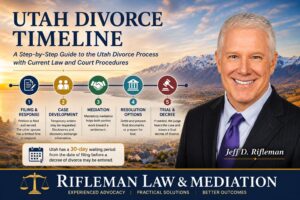
Utah requires a 30-day waiting period after filing. Contested divorce cases involving business valuation or child custody and child support disputes may take longer depending on court scheduling in Utah County.
How are businesses divided in a Utah divorce?
Businesses acquired or developed during the marriage may be considered marital property. Courts often require valuation analysis and may allocate ownership or structured buyouts to achieve equitable division.
Do I have to go to court?
Many Lindon divorce cases resolve through negotiation or mediation. Court hearings or trial may be necessary when disputes cannot be resolved.
Can alimony be modified later?
Yes. A substantial and material change in circumstances must be proven before a court will modify an existing alimony order.
Lindon Divorce Lawyer Focused on Stability and Structure
Divorce in Lindon often involves long-term assets, business interests, and deeply rooted parental relationships. The legal decisions made during divorce shape financial independence and parenting stability for years.
Rifleman Law & Mediation represents clients in Lindon and throughout Utah County in matters involving:
- Divorce
- Child custody and Parent Time
- Child Support
- Division of Property and Debts
- Alimony
- Enforcement of Orders
- Divorce Decree Modifications
- Mediation
If you are facing divorce in Lindon, structured legal strategy and disciplined preparation are essential to protect your financial future and parental rights.
