
Can I Move Out of State With My Children After Divorce in Utah?
Relocation cases are among the most difficult and emotionally charged issues in family law. A parent may have a legitimate reason to move out of state, such as employment, family support, remarriage, or financial necessity. At the same time, the move may substantially affect the child’s relationship with the other parent and the practicality of the existing custody arrangement.
That is why relocation issues should be approached carefully and early. A parent should not assume that wanting to move, or even having a good reason to move, automatically resolves the legal question.
If you are dealing with a possible move after divorce, it may be helpful to review related services involving modification, child custody, and broader Utah divorce representation.
Why Relocation Cases Are So Significant
Moving out of state can affect almost every part of a custody case. Parent-time schedules may no longer be workable. School-year exchanges may become impractical. Transportation costs may increase. Regular contact between the child and the nonmoving parent may be substantially reduced.
For those reasons, relocation is usually not just a logistical issue. It is a custody issue.
Questions That Often Matter in Relocation Cases
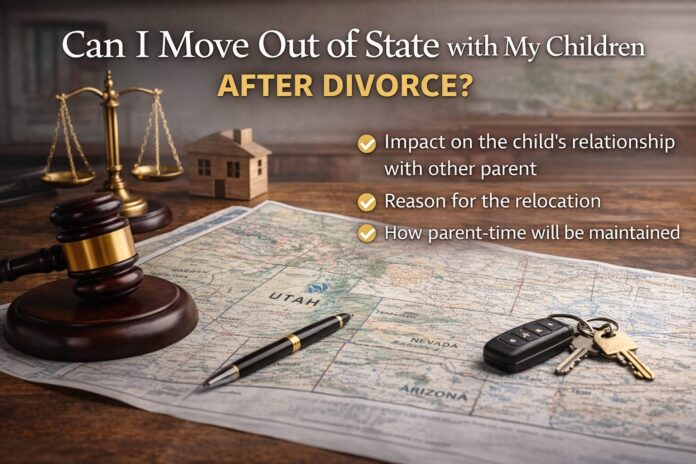
What is the reason for the move?
The reason for the proposed relocation often matters. Courts and opposing counsel are likely to look closely at whether the move is tied to a legitimate opportunity or need, or whether it appears designed primarily to interfere with the other parent’s relationship with the children.
How will the move affect the child’s relationship with the other parent?
One of the central practical questions is how meaningful parent-time will be preserved if the move occurs. That may involve longer blocks of time during school breaks, different holiday schedules, and detailed transportation arrangements.
What is the current custody structure?
The existing custody and parent-time arrangement matters. A move may have a different impact in a case with equal or near-equal parent-time than in one where one parent has historically exercised limited time.
What is best for the child?
Ultimately, relocation disputes usually come back to the child’s overall welfare, stability, and relationships. A proposed move may offer benefits, but those benefits must be considered alongside the disruption the move may cause.
Why Parents Should Not Handle This Casually
Relocation disputes can quickly become high-stakes litigation. A parent considering a move should think not only about the move itself, but also about what modification requests, parenting-plan revisions, transportation provisions, and support adjustments may be required if the move becomes part of the case.
Parents facing these issues may also need to review related topics such as child support, mediation, and future enforcement concerns if the current order is already unstable.
Relocation Often Requires a New Parenting Plan
Even when a move is legally supportable, the existing parent-time schedule may need a substantial rewrite. Travel logistics, communication expectations, school calendars, notice requirements, and holiday allocations often need to be addressed in detail.
In other words, relocation cases are not only about whether a move may happen. They are also about what the new structure will look like if it does.
Get Legal Guidance Before Making a Move
If you are considering moving out of state with your children after divorce, or if the other parent is proposing to do so, careful legal analysis matters. To learn more about Utah divorce, custody, and modification issues, visit Rifleman Law & Mediation.