
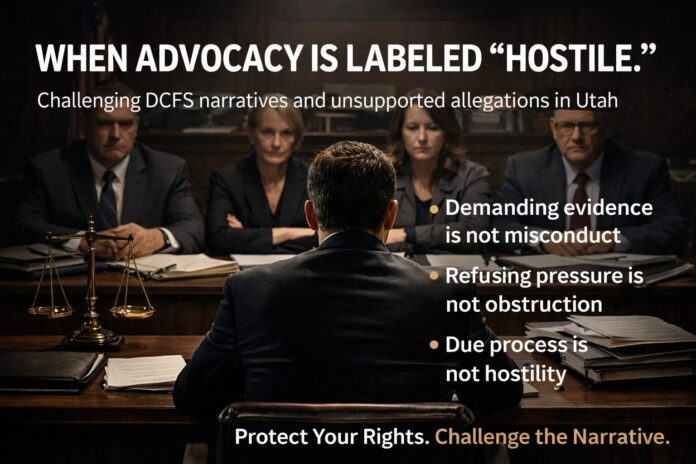
When “Advocacy” Is Labeled Hostile: Challenging State Overreach in Utah Custody and DCFS Cases
There is a recurring pattern in high-conflict custody and DCFS-involved cases that deserves direct attention: when a parent—refuses to accept unsupported allegations or predetermined outcomes, and challenges those through representation (ie an attorney) that resistance is often reframed as “hostility”.
This is from a recent DCFS internal communication resulting from an attorney challenging DCFS’s allegations:
“Father is nice… his attorney has been horrible to work with (known to be mean and dominate over conversations/bully into someone agreeing to their stance), so we have not been able to safety plan.”
This is not a coincidence. It is a systemic response. And if you are involved in a custody dispute, a DCFS investigation, or a case involving a guardian ad litem, understanding this dynamic is critical to protecting your rights, your relationship with your children, and your long-term legal position.
(See Also: DCFS and the Miracle in Courtroom 3)
The Closed System Problem in DCFS and Custody Cases
In many cases involving DCFS or contested custody litigation, a familiar alignment begins to form. The state’s attorney, the CPS caseworker, the guardian ad litem, and in some cases opposing counsel, begin operating from a shared assumption about what the outcome should be – a consensus formed from relationships formed from having interacted on multiple cases and often interacting on a daily basis with each other. (ie the Lunchtable Team.) Once that assumption is formed, the process often shifts away from testing evidence and toward reinforcing a foregone conclusion.
Parents who cooperate without question are often viewed as “reasonable.” Parents who push back— or better, their attorney, who ask for evidence, who challenge inconsistencies, who demand due process—are labeled “difficult,” “uncooperative,” or “hostile.” – because they are ‘bucking the consensus system’. That is where the real danger begins.
The legal system is not supposed to reward compliance for its own sake. It is supposed to evaluate facts, credibility, and evidence. When that standard begins to erode, parents can find themselves defending not only against allegations, but against an institutional narrative that has already started to harden.
If you are dealing with these issues, it is important to understand how Utah child custody litigation works and how quickly a case can be shaped by early assumptions if those assumptions are not challenged.
When Refusing to Agree Becomes “Bullying”
It is not uncommon to see reports or communications that characterize an attorney as “dominating,” “mean,” “difficult,” or “bullying.” But in many cases, that characterization has very little to do with tone and everything to do with resistance.
When an attorney refuses to accept unsupported allegations, demands documentation, challenges vague or inconsistent claims, or declines to agree to overreaching “safety plans,” that attorney is not obstructing the process. That attorney is doing exactly what competent legal representation requires.
That is not bullying. That is advocacy.
And in many custody disputes, especially those involving DCFS or guardian ad litem recommendations, advocacy itself becomes the problem in the eyes of those who expect compliance. The moment counsel refuses to capitulate, the attorney’s refusal is reframed as aggression instead of professionalism.
This is one reason strategic representation matters in cases involving child custody disputes in Lehi and throughout Utah County. If the other side is trying to turn your defense into a character issue, your case needs more than passive participation. It needs structure, discipline, and a clear response.
The Misuse of “Safety Planning” in DCFS Cases
“Safety planning” is often presented as a neutral, child-focused tool. In the right circumstances, it can be. But in contested custody disputes, it can also become a mechanism for pressure and leverage. Parents are sometimes asked to agree to limitations, concessions, or restrictions before the factual basis for those demands has been properly tested.
When that happens, the issue is no longer genuine child protection. It becomes leverage.
A parent may be asked to accept reduced parent-time, supervision, behavioral conditions, or vague compliance obligations based on allegations that remain unsubstantiated. If that parent, through counsel, refuses to agree without proof, the narrative often changes immediately. Refusal becomes “non-cooperation.” Advocacy becomes “aggression.” Due process becomes “delay.”
This tactic can be especially damaging in cases involving American Fork child custody disputes and other Utah cases where temporary arrangements can later be used as a basis for longer-term rulings.
The Core Legal Problem: Presumption Replacing Proof
At the center of these cases is a simple but essential principle: allegations are not evidence. Suspicion is not proof. Consensus among state-aligned actors is not a substitute for factual support.
But in practice, once a narrative gains traction, it can start operating as though it has already been proven. The burden quietly shifts. Instead of the accusing side being required to prove its claims, the parent accused is pressured to disprove them while also demonstrating cooperation with the very assumptions being challenged.
That inversion is deeply problematic. It is not how due process is supposed to function. And it is one reason a parent’s case can deteriorate quickly if unsupported accusations are not challenged early and directly.
If your custody case involves allegations that are being treated as fact before they have been properly tested, it is essential to respond with a deliberate legal strategy. That is particularly true in cases involving child custody and parent-time disputes in Saratoga Springs and throughout the Wasatch Front.
Why Strategy Matters More Than Passive Cooperation
Many parents understandably believe that being cooperative will produce better outcomes. In some contexts, cooperation is useful. But in high-conflict custody litigation, cooperation without strategy can become a liability.
Every agreement, every concession, and every temporary restriction can become part of the record. What feels temporary in the moment can later be cited as a workable arrangement, an admission of concern, or a reason to maintain the status quo. That is why decisions made early in a case matter so much.
You should not agree to terms simply because state actors present them with institutional confidence. You should agree only when the facts, the law, and your long-term litigation position support doing so.
Working with a divorce and custody attorney in Lehi who focuses on strategy—not merely expedient resolution—can make the difference between preserving your rights and unintentionally surrendering them.
How Resistance Gets Reframed as Misconduct
One of the most troubling features of these cases is how quickly legitimate advocacy is recast as improper behavior. When an attorney challenges weak claims, asks hard questions, or refuses to endorse a predetermined outcome, the response from the system is often not engagement with the merits. It is characterization.
Reports may describe communication issues. Professionals may express vague “concerns” about cooperation. A parent’s attorney may be portrayed as difficult for declining to validate unsupported assumptions. Over time, those labels can begin influencing judicial perception if they are not confronted and corrected.
This is not a small issue. In many cases, it becomes the issue.
Once the focus shifts away from whether allegations are supported and toward whether the parent is being “cooperative enough,” the entire case can become distorted. That distortion can affect temporary orders, evaluations, recommendations, and the court’s overall view of credibility.
If false narratives or overreaching recommendations are affecting your case, it may be necessary not only to defend against the allegations, but also to pursue enforcement and corrective relief where appropriate. Learn more about your options with a Utah divorce enforcement attorney.
This Is Not Child Protection. It Is Institutional Pressure
Child protection is a legitimate and necessary function. But genuine child protection requires evidence, fairness, and restraint. It does not require blind agreement. It does not justify pressuring parents into concessions based on unsupported claims. And it does not allow state-aligned professionals to collapse due process into a demand for compliance.
When an attorney’s defense against weak allegations is reframed as obstruction, the system stops functioning as a neutral evaluator and begins functioning as an enforcement mechanism for its own assumptions. That should concern anyone who values fairness, family integrity, and the rule of law.
The issue is not tone. The issue is not whether an attorney was agreeable enough for the preferences of the state or a guardian ad litem. The issue is whether major decisions affecting a parent and child are being grounded in evidence or in institutional convenience.
Protecting Your Position in a High-Conflict Utah Custody Case
If your case involves DCFS, a guardian ad litem, or allegations that are being repeated more confidently than they are being proven, you should move carefully and strategically. That means documenting communications, preserving inconsistencies, refusing unsupported concessions, and insisting that serious claims be tested rather than assumed.
It also means understanding that these cases are often shaped by narrative momentum. If you allow unsupported assumptions to remain unanswered, they can become embedded in reports, recommendations, and court proceedings. Once that happens, undoing the damage becomes more difficult and more expensive.
A strong response is not about theatrics. It is about discipline. It is about making sure that your case is not defined by allegation, convenience, or institutional groupthink.
Do Not Let the System Define Your Case Without Challenge
If you are being accused, investigated, or pressured into agreements based on incomplete or unsupported allegations, one of the most important decisions you will make is how you respond. Early concessions can become long-term outcomes. Unchallenged narratives can become judicial findings.
You need a strategy—not just participation in the process.
At Rifleman Law & Mediation, representation is built around evidence-based advocacy, disciplined case positioning, and protecting parental rights against overreach and pressure tactics. If your custody case involves DCFS, a guardian ad litem, contested allegations, or an effort to turn your defense into a liability, now is the time to act.
Schedule a consultation with Rifleman Law & Mediation
Related Utah Family Law Resources
- How Divorce Works in Lehi, Utah
- Child Custody and Parenting Plans in Lehi
- What Happens When a Parent Violates a Custody Order in Lehi?
- Divorce Mediation vs. Litigation in Lehi
- Saratoga Springs Divorce Lawyer and Child Custody Attorney
- Lehi Divorce Lawyer and Child Custody Attorney
- American Fork Divorce Lawyer and Child Custody Attorney
