
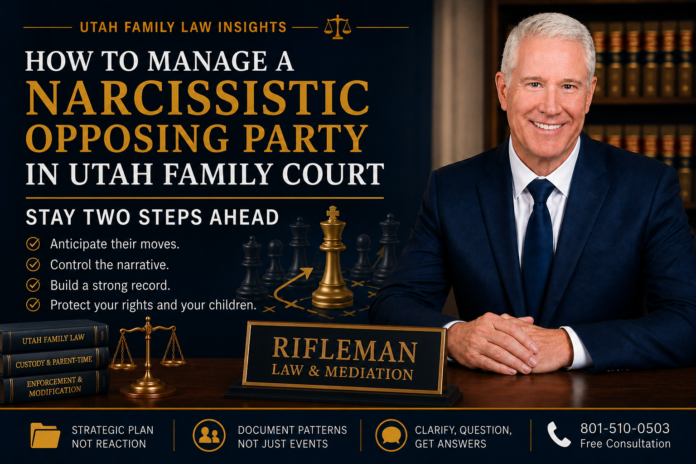
How to Deal With a Narcissist in Utah Family Court by Staying Two Steps Ahead
By Jeff D. Rifleman, Rifleman Law & Mediation
Dealing with a narcissistic opposing party in a Utah divorce or child custody case requires a different strategy than dealing with an ordinary disagreement between reasonable people. In a typical family-law dispute, the parties may disagree strongly, but they can often identify the issue, exchange information, and eventually work toward a resolution. A narcissistic or highly manipulative opposing party frequently has a different objective. Rather than resolving the dispute, the person may seek to control the narrative, create confusion, avoid accountability, and keep the other party constantly reacting.
That reactive position is precisely where a narcissist wants the other party to remain. Every new accusation requires an explanation. Every revision of history creates another factual dispute. Every unanswered email may later be characterized as an agreement. Every emotional response may be used as supposed proof that the other parent is unstable, unreasonable, or difficult to work with.
Whether the dispute involves a Utah divorce, a contested child custody case, parent-time interference, enforcement of a court order, or a post-decree modification, the better strategy is to stop reacting and begin anticipating. The goal is to remain two steps ahead by understanding the opposing party’s likely responses and preparing for each of them before the first communication is sent.
This approach creates a litigation playbook. Before sending an email, making a settlement proposal, or raising an issue with opposing counsel, determine the two most likely ways the narcissistic party will respond. Then prepare the next response for both possibilities. When done correctly, the opposing party is no longer leading the conflict. Instead, the communication is being directed toward a factual record, a clear decision, or an admission that can later be understood by a Utah family court commissioner or district court judge.
Why Narcissistic Behavior Can Be Difficult to Identify in a Utah Custody Case
Narcissistic behavior is not always loud or obvious. Some narcissistic parties are openly aggressive. They may send hostile messages, make threats, refuse to follow court orders, or repeatedly attack the other parent. Others operate through covert narcissism. They may appear calm, polite, and cooperative while quietly withholding information, distorting prior conversations, making false accusations, or setting traps designed to make the other parent appear unreasonable.
This presents a particular problem in a Utah child custody and parent-time case. Commissioners and judges usually see only a small portion of the parties’ interactions. A narcissistic parent may appear composed during a short hearing while the targeted parent appears frustrated after months or years of gaslighting, obstruction, and manipulation. Without a carefully organized record, the court may see only the reaction rather than the behavior that caused it.
For that reason, repeatedly telling the court that the opposing party is a narcissist is rarely the most effective approach. Unless a qualified mental-health professional has made an appropriate diagnosis, the label itself may create unnecessary disputes. The stronger litigation strategy is to document the underlying conduct.
Instead of arguing that the other parent is narcissistic, the evidence should demonstrate that the parent repeatedly refused to answer direct questions, made contradictory statements, denied receiving communications that were clearly delivered, interfered with court-ordered parent-time, withheld information about the children, or attempted to create a false agreement through silence.
When the conduct is documented clearly, the court does not need to diagnose a personality disorder. The court can evaluate the legally relevant behavior: dishonesty, obstruction, poor communication, noncompliance with court orders, and unwillingness to support a functional co-parenting relationship.
Stop Explaining Yourself to the Narcissist
One of the most common mistakes in high-conflict Utah family-law litigation is attempting to answer every accusation with a lengthy explanation. Narcissistic parties frequently make broad allegations such as, “You never cooperate,” “You do not care about the children,” or “You are always trying to control everything.” These statements are intentionally vague. They invite the other person to respond emotionally and provide pages of unnecessary explanation.
The intent should not be to explain yourself to the narcissist. The intent should be to require the narcissist to explain the allegation.
If the other parent claims that Father never cooperates, the response should not be a detailed history of every cooperative act during the marriage. A more effective response would ask the parent to identify the specific request that Father allegedly refused, the date of the request, and the response that was supposedly inappropriate.
If the opposing party claims that the children are afraid, the response should request the date of the alleged statement, the person to whom it was made, the context in which it was made, and the exact language the children supposedly used.
Focused questions change the direction of the communication. The accused party is no longer attempting to disprove a vague generalization. The person making the allegation must now identify facts that can be compared against messages, calendars, witnesses, school records, medical records, or prior sworn statements.
Create Two Predictable Paths Before Sending the First Email
Staying two steps ahead requires more than writing a strong response. It requires anticipating what happens next.
Before sending a material communication, consider whether the opposing party is likely to agree, deny, deflect, or ignore the question. In many situations, the communication can be structured so that the opposing party has only two reasonable choices. A prepared response should already exist for either direction.
For example, suppose the other parent states that Father has never requested additional parent-time. A reactive response might accuse the parent of lying and attach months of text messages. A more strategic response would state:
“Your email states that Father has never requested additional parent-time. Are you denying that Father requested additional time in his messages dated May 12, June 4, and July 1? Please answer yes or no so that your position is clear.”
The opposing party now has limited options. If the answer is yes, the messages can be produced and the denial can be disproved. If the answer is no, the original allegation has effectively been abandoned. If the question is ignored, a follow-up can establish that the party refused to answer a direct factual inquiry.
Each possible response moves the case in a useful direction. The communication is not merely defensive. It is designed to lead the opposing party toward a position that can later be evaluated by the court.
Correct False Statements Before They Become the Written History of the Case
A narcissistic opposing party may place an inaccurate statement into an email and then rely upon the absence of an immediate response. Months later, the person may argue that no one objected, that the parties had an agreement, or that the statement was accepted as true.
This is a common form of plausible deniability in high-conflict divorce and custody litigation. The person is not necessarily asking for agreement. The person may simply be placing a version of events into the written record and waiting to see whether it is challenged.
Material falsehoods should be corrected promptly. The response does not need to be hostile, lengthy, or emotional. It should identify the inaccurate statement, provide the correct fact, and require clarification when appropriate.
For example, if the opposing party writes, “As we previously agreed, the children will remain with Mother this weekend,” the response should make clear that no such agreement exists:
“There was no agreement that the children would remain with Mother this weekend. The current order provides that this is Father’s weekend, and Father intends to exercise his court-ordered parent-time. Please confirm that the children will be available at the required exchange time.”
This type of response serves several purposes. It eliminates any suggestion of consent, identifies the controlling court order, and requires the opposing party to state whether the order will be followed.
When a parent repeatedly disregards an existing custody or parent-time order, the issue may require an enforcement action in Utah family court. A clear written record showing the request, the applicable order, and the refusal to comply can be significantly more persuasive than a general allegation that the other parent is difficult.
Turn Gaslighting Into a Demand for Facts
Gaslighting succeeds when the discussion remains vague. A narcissistic party may deny a conversation occurred, claim that an agreement was reached when it was not, or insist that the other party misunderstood an obvious statement. The targeted person may then spend substantial time debating memories, motives, and interpretations.
The appropriate response is not to argue about perception. It is to demand objective support.
If the opposing party claims that an agreement was reached, ask for the written communication containing the agreement. If the party claims a court order allows certain conduct, request the specific provision of the order. If the party claims an incident occurred, request the date, time, location, witnesses, and supporting evidence.
Suppose the other parent writes, “You agreed months ago that I could select the children’s school.” A strategic response would state:
“I am not aware of any agreement granting either parent unilateral authority to select the children’s school. Please produce the communication in which that agreement was allegedly made. Unless such an agreement exists, I do not consent to a unilateral change.”
The response does not attempt to prove that no conversation ever occurred. It places the responsibility upon the person asserting the agreement to produce it. It also eliminates the possibility that silence will later be characterized as consent.
In a Utah custody dispute, this type of precise communication can be particularly important when the parents disagree about school placement, medical care, counseling, extracurricular activities, religious decisions, or other matters involving joint legal custody.
Make the Narcissistic Party Answer the Question Actually Asked
Narcissistic and high-conflict parties frequently respond without answering. A direct question about whether the children will be available for parent-time may receive a lengthy response about events from five years earlier. A request for medical information may be answered with an accusation that the requesting parent is controlling. A question about compliance with a court order may be met with criticism of the other attorney.
Do not allow the deflection to become the new subject of the discussion.
A concise follow-up should state that the response did not answer the question and should repeat the question in a form that permits a direct answer:
“Your response did not answer whether Mother will make the children available at the court-ordered exchange time. Please confirm whether Mother will comply with the existing order.”
This technique is not intended to harass the opposing party. It is designed to establish whether the person will answer a reasonable question involving the children or an existing legal obligation.
Even when the answer is not the answer the client wants, a direct answer provides useful information. If the parent agrees to comply, the immediate issue may be resolved. If the parent refuses, the refusal is documented. If the parent continues to evade the question, the pattern of nonresponsive communication becomes increasingly clear.
Build a Pattern Rather Than Arguing About Isolated Incidents
One hostile email may not persuade a Utah family court that intervention is necessary. One missed exchange may be described as a misunderstanding. One failure to provide information may be dismissed as an oversight. A repeated pattern, however, can demonstrate that the issue is not accidental.
For that reason, attorneys and clients dealing with a narcissistic opposing party should organize communications chronologically. The record should identify the date of the request, the issue presented, the response received, whether the question was answered, whether the response contradicted an earlier statement, and how the conduct affected the children or compliance with the court’s order.
The purpose is not to preserve every rude comment. Courts are generally not interested in resolving every interpersonal insult between former spouses. The record should focus on conduct that affects legal custody, physical custody, parent-time, child support, financial disclosure, property division, or compliance with existing orders.
In some cases, a continuing pattern of obstruction, interference, or inability to communicate may support a request for a Utah child custody or divorce decree modification. In other cases, the documentation may support a motion to enforce the existing order or may become relevant during mediation, a custody evaluation, an evidentiary hearing, or trial.
Professional Persistence Is Different From Aggression
Attorneys representing clients against narcissistic or manipulative parties sometimes face a difficult problem. Repeatedly correcting falsehoods and demanding direct answers may appear aggressive when an individual email is viewed in isolation. However, failing to correct the record may leave the client exposed to false claims, manufactured agreements, and continuing violations of court orders.
The answer is professional persistence.
Communications should remain factual, direct, and proportionate to the issue. They should not contain insults, sarcasm, amateur psychological diagnoses, or unnecessary threats. The goal is not to provoke the narcissistic party. The goal is to remove ambiguity and preserve the client’s legal position.
When a commissioner or judge does not immediately understand the pattern of narcissistic behavior, the written record must do the work. The record should demonstrate what was requested, why the request was reasonable, how the opposing party responded, whether the response was truthful, and whether the same type of conduct occurred repeatedly.
This can be particularly important in high-conflict cases involving a Saratoga Springs divorce lawyer, a Lehi divorce and child custody attorney, or an Eagle Mountain child custody lawyer, where the parties may continue co-parenting for many years after the original case is resolved.
Do Not Let the Narcissist Choose the Narrative
A narcissistic party often seeks to control the litigation by deciding which accusation everyone must discuss next. The other party is placed in the position of constantly defending, explaining, and disproving. This allows the narcissistic party to avoid answering questions about his or her own conduct.
The solution is to refuse that framework.
Rather than answering every accusation, determine whether the allegation is legally relevant. If it is relevant, require the opposing party to identify the supporting facts. If it is not relevant, do not allow it to distract from the issue that must be resolved.
The intent is not to manipulate the other party into making a false admission. The intent is to create a structured communication process in which the person must either provide facts, withdraw the allegation, state a position, or refuse to answer.
A narcissistic opposing party may be accustomed to having a former spouse repeatedly explain and defend himself or herself. The dynamic changes when the opposing party is instead required to clarify, document, and account for what was said or done.
Using Mediation in a High-Conflict Divorce Involving Narcissistic Behavior
Not every case involving narcissistic behavior must proceed directly to trial. In some circumstances, Utah divorce mediation can be used to narrow the issues and create detailed, enforceable agreements.
However, mediation involving a narcissistic or highly manipulative party requires preparation. The client should not enter mediation expecting the opposing party to suddenly acknowledge past misconduct or behave reasonably. The mediation strategy should anticipate predictable demands, identify acceptable alternatives, and prepare responses to likely attempts to change the subject or create a false sense of urgency.
Detailed settlement language is also essential. Vague agreements create future opportunities for manipulation. Provisions involving exchange times, transportation, school decisions, medical information, communication deadlines, holiday schedules, and reimbursement procedures should be written with enough specificity to reduce later disputes.
Strategic Representation in High-Conflict Utah Family-Law Cases
Cases involving narcissistic behavior, gaslighting, chronic noncompliance, and coercive communication require disciplined preparation. The goal is not merely to write stronger emails. The goal is to create a strategy in which each communication moves the case toward clarification, accountability, or enforceable relief.
Rifleman Law & Mediation represents clients in high-conflict Utah divorce cases, contested child custody and parent-time disputes, family court enforcement proceedings, and post-decree modifications.
The firm serves clients throughout Utah County and surrounding communities, including individuals seeking a Saratoga Springs divorce lawyer, Lehi divorce lawyer, Eagle Mountain divorce lawyer, American Fork divorce lawyer, and Provo divorce lawyer.
Preparation Removes the Narcissist’s Advantage
The objective is not to win an argument with a narcissist. The objective is to prevent the narcissistic party from controlling the record through confusion, gaslighting, plausible deniability, and repeated demands that everyone else explain themselves.
Staying two steps ahead means anticipating the likely answer before asking the question. It means preparing a response for either direction. It means correcting material falsehoods immediately, requiring supporting facts, documenting evasions, and refusing to become distracted by allegations that do not affect the legal issues before the court.
Narcissistic and manipulative parties are often comfortable when everyone else is reacting. They are less comfortable when the communication is structured, the questions are precise, and every possible response leads toward greater accountability.
In a Utah divorce or custody case, that preparation can protect the client, clarify the evidentiary record, and help the court evaluate the opposing party’s actual conduct rather than the narrative the person is attempting to create.
To discuss a high-conflict Utah divorce, child custody, parent-time, enforcement, or modification matter, contact Rifleman Law & Mediation at 801-510-0503 to schedule a confidential consultation.
This article provides general information concerning Utah family-law strategy and is not legal advice regarding any particular case. References to narcissistic behavior describe patterns of high-conflict or manipulative conduct and are not intended to constitute a clinical diagnosis.
