
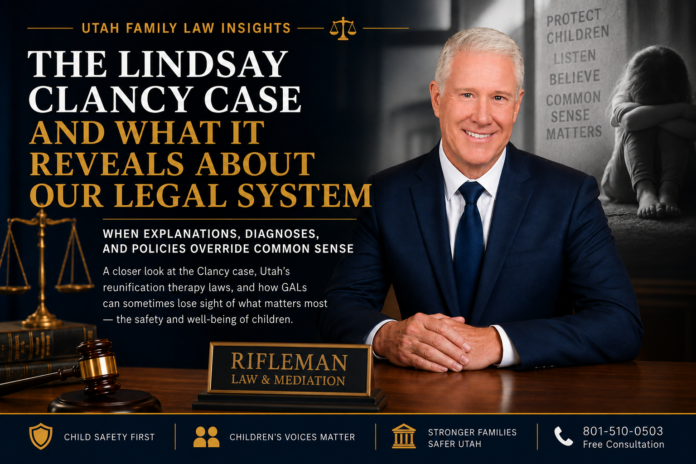
When Did Common Sense Become Controversial in Child Custody Cases?
By Jeff D. Rifleman, Rifleman Law & Mediation
There are some cases that force us to ask whether the legal system has become so focused on explanations, diagnoses, professional theories, and therapeutic objectives that it risks losing sight of something much more basic: what actually happened to the child.
The Lindsay Clancy murder case is one of those cases.
Clancy killed her three young children in Massachusetts. Her defense has centered on claims involving postpartum psychosis and mental illness, while prosecutors have contended that she understood what she was doing and acted deliberately. Whatever ultimately happens in the criminal proceedings, there is no dispute about the most important underlying fact: three children died at the hands of their mother.
Mental illness is real. Postpartum psychosis is real. Severe psychiatric disorders can alter perception, judgment, and behavior in profound ways. The law appropriately considers mental illness when determining criminal responsibility, treatment, and competency.
But explaining an adult’s behavior is not the same thing as erasing what the child experienced!
That distinction is increasingly important in family law, particularly in a Utah child custody and parent-time case involving allegations of abuse, severe mental instability, frightening parental conduct, or a child’s refusal to maintain a relationship with a parent.
At some point we have to ask a very simple question: when did protecting a child’s instinct for self-preservation become something secondary to that adults actions of abuse that caused the harm?
A Mental-Health Explanation Does Not Undo the Child’s Experience
One of the recurring problems in custody litigation is the tendency to focus heavily on why an adult behaved badly rather than on what the child experienced when the behavior occurred.
The adult may have been depressed. The adult may have experienced trauma. The adult may have suffered from psychosis, mania, PTSD, substance abuse, emotional dysregulation, or another psychiatric condition. Those facts can be relevant. Sometimes they are critically important. But children do not experience diagnostic terminology.
A child does not experience “bipolar disorder with psychotic features.” The child experiences a parent screaming, striking someone, destroying property, threatening people, behaving unpredictably, or becoming someone the child no longer recognizes. A child does not experience “trauma-induced fight-or-flight behavior.” The child experiences fear. A child does not experience “emotional dysregulation.” The child experiences an adult who suddenly becomes unsafe.
And a child who has experienced frightening conduct does not necessarily become willing to trust the parent merely because a therapist later provides a clinical explanation for why the conduct occurred.
This distinction matters for parents seeking a Saratoga Springs child custody lawyer, a Lehi child custody lawyer, or counsel in any contested Utah custody case involving mental-health concerns. A diagnosis may help explain conduct. It does not automatically restore trust.
The Family Court System Can Reverse the Question
The legal system is supposed to begin with the best interests of the child. Yet some high-conflict custody cases seem to begin somewhere else entirely.
The questions become:
How can we repair the parent’s relationship with the child? How can we get the child to engage? How can we overcome the child’s resistance? How can we get the child to lower emotional walls? What kind of therapy might help the child accept the parent again?
Those questions assume something very significant: that restoring the relationship is necessarily the correct objective. Sometimes it is. Sometimes a child has been improperly influenced by another parent. Sometimes there has been gatekeeping, manipulation, false information, or genuine parental alienation. A child may need assistance understanding a distorted family narrative.
But sometimes the child is not rejecting a parent because another adult created the problem. Sometimes the child remembers what happened. However, there is a push in Utah to ‘reunify’ that parent-child relationship at any cost – placing the aim at some idealistic relationship that just may not be in the child’s best interest. PGAL, counseling, and parental agendas often cloud the child’s true situation and voice in the matter.
A Child’s Fear May Be Evidence, Not Pathology
Consider a real-world type of scenario drawn from the facts of a Utah custody matter, with identifying information deliberately omitted.
An older child repeatedly states that she does not trust one parent after abuse is discovered. The court orders reunification therapy. She says that she does not presently want contact with that parent outside a therapeutic setting. She describes having previously felt unsafe during contact with that parent. She expresses prior abuse by that parent. She expresses a specific fear that if the parent experiences another serious psychiatric episode, she could be physically harmed.
The parent acknowledges prior episodes involving psychosis or mania, and abuse of the child. The parent acknowledges becoming physically aggressive toward other people during those episodes, including physical altercations. The parent then tells the child that she does not need to worry because if another episode develops, the parent will recognize the warning signs and take appropriate precautions.
From an adult therapeutic perspective, that may sound reassuring. From the child’s perspective, it may produce an entirely different question:
What happens if you do not recognize the warning signs next time? This places the burden on the child.
What if the child is experiencing ongoing trauma from the events?
That is not necessarily alienation from the parent and the child’s perspective must be considered and not swept aside.
It may be rational risk assessment.
Yet children expressing those concerns are sometimes characterized as resistant, rigid, avoidant, alienated, or even “just unsure”. Language matters. When we describe the child’s protective behavior as pathology, we subtly shift the problem from the adult who created the fear to the child who still remembers it.
Utah Reunification Therapy Law Recognizes That This Can Go Too Far
Utah law now expressly addresses what it calls reunification therapy.
Under Utah Code § 81-9-104, reunification treatment includes therapy or treatment “aimed” at reuniting or reestablishing a relationship between a minor child and an estranged or rejected parent or family member.(That language “aimed’ is critical. Providers, GAL’s, and courts often confuse this with outcome. We aim at goals all the time. Many are not reached. The foregone conclusion that the parent-child relationship will return to where it was prior to the estrangement is flawed logic. So many variables affect ‘aim’, including prior abuse, willingness to re-engage a parent, ongoing mental issues, trust and boundary issues, etc.)
The language itself reveals the objective: reunification or reestablishment of the relationship.
There is nothing inherently wrong with that objective. Children ordinarily benefit from healthy relationships with both parents. Utah custody law repeatedly recognizes the importance of meaningful parent-child relationships. But Utah lawmakers have also recognized that reunification cannot be treated as an unquestioned objective where violence or abuse has caused the estrangement.
The statute places restrictions around expert evidence, findings of abuse, and reunification-related treatment. Those restrictions are important because a therapeutic model intended to repair a damaged relationship can become dangerous if it assumes that the child’s resistance is itself the condition needing treatment.
That is particularly relevant in contested cases handled by a Eagle Mountain child custody lawyer, an American Fork child custody lawyer, or a Provo child custody lawyer, because allegations of abuse and estrangement can quickly become entangled with claims of parental alienation and requests for reunification therapy.
Reunification Should Not Mean Predetermined Reconciliation
There is a conceptual problem with some forms of reunification therapy. The very term can predetermine the desired outcome.If therapy is defined by the goal of reuniting the child and parent, what happens when the evidence demonstrates that the child’s refusal is based on actual frightening or abusive conduct? The therapy can cease being an investigation into whether trust should be restored and instead become a process designed to persuade the child that trust ought to be restored.
Those are not the same thing.
A legitimate therapeutic process should be able to conclude that the child needs distance, that the parent needs substantial treatment before contact expands, or that reconciliation must occur slowly and only when the child develops genuine confidence that circumstances have changed.
A process that considers only one acceptable outcome is not really evaluating the child’s interests. It is implementing an adult objective.
We Would Never Treat an Adult Victim This Way
The inconsistency becomes obvious when we compare children to adults. Imagine an adult woman whose partner becomes psychotic, physically aggressive, and terrifying. She leaves. Months later the partner receives treatment and says the episode was caused by mental illness. Would society tell her that because the medical explanation has now been identified, she must rebuild trust? Would we order her into therapy specifically designed to restore intimacy? Would we call her “resistant” because she remained cautious? Would we characterize her refusal to spend unsupervised time with the person as “stonewalling”?
Probably not. We would likely say trust has to be earned. We might say that treatment is encouraging but does not erase history. We might tell her she has a legitimate right to assess her own safety. Children deserve at least as much consideration.
Guardian ad Litem Does Not Mean Substitute Parent
Another point of tension arises when a private attorney guardian ad litem becomes involved in a contested Utah custody dispute.
Under Utah Code § 78A-2-705, a court may appoint a private attorney guardian ad litem in a district court action when custody or parent-time is at issue. The private attorney guardian ad litem represents the minor’s best interests. That does not mean the child’s stated wishes control. But it also does not mean they disappear.
Utah law expressly addresses the situation in which the child’s intent and desires differ from the private attorney guardian ad litem’s own determination of the child’s best interests. The statutory framework requires that distinction to be communicated to the court. That requirement is significant. It means the Legislature recognizes two separate concepts: what the child wants, and what the GAL believes is best. A court should be able to hear both.
The danger arises when the GAL’s “best interest” opinion becomes so dominant that the child’s actual experience gets filtered, minimized, or translated into professional language before it ever reaches the decision-maker.
The GAL’s Opinion Is Still an Opinion
A private attorney guardian ad litem has an important responsibility, but the title does not create omniscience. A GAL is still evaluating facts. The GAL may form a view of the family based on interviews, records, communications, therapeutic reports, and professional judgment. That opinion may be persuasive. It may even be correct.
But when a child consistently and articulately reports fear, distrust, and a desire for limited contact following documented frightening conduct, those statements should not simply be reinterpreted until they fit the professional’s theory of what the child needs. The child’s voice cannot become meaningful only when the child agrees with the adults.
This issue frequently arises in complex cases involving a Orem divorce lawyer and child custody attorney, Provo divorce lawyer and child custody attorney, or another Utah family law attorney dealing with contested parent-time, abuse allegations, or court-ordered therapy.
Best Interests Cannot Become an Empty Phrase
“Best interests of the child” is one of the most powerful phrases in family law. It is also one of the easiest phrases to misuse. Everyone claims to be acting in the child’s best interests. The parent seeking more contact says the relationship is in the child’s best interests. The parent seeking restrictions says safety is in the child’s best interests. The therapist says treatment is in the child’s best interests. The GAL says the GAL’s recommendation is in the child’s best interests. A custodial evaluator may present a professional opinion (based on statutory requirments) what the believe is the child’s best interests. The court must eventually decide. But the phrase should never become a substitute for analysis.
The question is not merely whether relationships with parents are generally beneficial. Of course they are. The question is whether this particular relationship, under these particular circumstances, in this particular form and at this particular time benefits this particular child.
That is the type of fact-intensive analysis required in a serious Saratoga Springs divorce and child custody case or a contested Lehi divorce and child custody case.
Relationship Preservation Is Not More Important Than Safety
I strongly support maintaining meaningful relationships between children and both parents.
In appropriate cases, I believe Utah courts should be more willing—not less willing—to provide substantial and even equal parent-time to two fit and involved parents.
Those principles are not inconsistent with what I am saying here. Healthy relationships should be preserved. Dangerous relationships should be treated differently. A parent should not lose a child merely because the other parent makes an allegation. Allegations require proof. Mental illness alone should not disqualify a parent. A past diagnosis does not establish present danger.
But neither should courts react to actual evidence of frightening or abusive conduct by immediately shifting the focus to how quickly the damaged relationship can be restored.
First determine why the relationship was damaged. Then determine whether the conditions causing the damage have actually changed. Then determine what level of contact is presently safe. Only then should the system decide how, whether, and at what pace greater contact should occur.
Trust Cannot Be Ordered
A court can order parent-time. A court can order therapy. A court can order exchanges. A court can order telephone calls. A court can order a child to attend counseling.
But a court cannot order trust. Trust is psychological, not judicial. A therapist cannot simply explain enough psychiatric terminology to make a child forget an experience that frightened the child.
The offending parent must often do the much harder work: accepting responsibility, demonstrating stability, respecting boundaries, showing consistency, and allowing enough time for the child to determine whether the change is real.
Attempts to rush that process can actually make reunification harder. If the child perceives that every adult in the system is insisting that the child stop being afraid, the child may conclude that no adult is actually listening. That does not build trust. It destroys it.
The Problem With Calling Everything Alienation
Parental alienation, gatekeeping, and estrangement is real.
There are parents who deliberately damage a child’s relationship with the other parent. They make false accusations, interfere with parent-time, disparage the other parent, manipulate the child’s perceptions, involve the child in litigation, and create loyalty conflicts.
That conduct can be extremely harmful. But the existence of parental alienation does not mean that every estranged child has been alienated. Sometimes a child has legitimate reasons for rejecting a parent. Failing to distinguish between the two can produce disastrous results.
If every child’s refusal is interpreted as evidence that the favored parent manipulated the child, actual abuse can be transformed into evidence against the protective parent. The abusive conduct causes the child to resist. The resistance is labeled alienation. The protective parent is blamed for the resistance. The child is ordered into reunification therapy. And the parent whose conduct originally caused the problem becomes the person the system is working hardest to rehabilitate relationally.
That is an inversion of common sense.
A Child Can Understand More Than Adults Sometimes Give the Child Credit For
Older children are especially important in this discussion. An adolescent is capable of observing patterns. A teenager may understand that a parent has periods of instability. The child may recognize when promises have been broken before. The child may remember incidents that professionals only know about through reports and interviews. The child’s analysis may be imperfect. Children can misunderstand events. They can be influenced.
But adults can also misunderstand events and be influenced. Professional credentials do not make an adult immune from confirmation bias. If the therapist begins with the hypothesis that the child is alienated, subsequent behavior may be interpreted through that lens. Silence becomes resistance. Fear becomes avoidance. Boundaries become rigidity. Distrust becomes pathology.
At some point we should consider another possibility: perhaps the child is telling the truth about how the child feels.
Sometimes “Common Sense” Is a Legitimate Starting Point
The legal profession appropriately values evidence, expertise, and careful analysis. But expertise should supplement common sense, not eliminate it.
When a child touches a hot stove and becomes reluctant to touch it again, we call that learning. When a person is bitten by a dog and becomes cautious around that dog, we understand why. When an adult is assaulted and avoids the attacker, we generally consider that self-protective. When a child experiences frightening conduct from a parent and becomes afraid of being alone with that parent, we should at least begin by asking whether the fear is rational.
We should not immediately assume that the child’s emotional response is something that needs to be corrected.
The Lindsay Clancy Case Illustrates the Larger Cultural Problem
The Lindsay Clancy case is an extreme example, but it highlights a broader social tendency. We have become very sophisticated at explaining adult behavior. Sometimes so sophisticated that we risk forgetting the victim. We talk about the offender’s trauma. We talk about diagnosis. We talk about medication. We talk about treatment failures. We talk about social pressures.
Those can all be important. But there must remain room to say: This happened. It harmed a child. And the child’s reaction to what happened is entitled to respect. Compassion for a mentally ill parent and protection of a child are not mutually exclusive. But when those interests actually conflict, the legal system should remember who the custody case is supposed to protect – the child.
Parents Have Rights, But Children Are Not Therapeutic Instruments
Parents possess fundamental constitutional rights regarding their children. Those rights matter enormously. A parent should not lose custody because someone dislikes the parent’s lifestyle, beliefs, personality, or parenting style. Courts should not casually interfere with families. But parental rights do not transform the child into an instrument for the parent’s rehabilitation.
A child does not exist so that a parent can prove recovery. A child does not owe a parent emotional reconciliation because the parent completed treatment. A child does not become responsible for restoring an adult’s sense of parental identity.
The legal system should protect parent-child relationships because those relationships ordinarily benefit children—not because biology creates an unconditional entitlement to access regardless of what has occurred.
Utah Child Custody Law Should Continue Moving Toward Evidence, Not Ideology
The correct approach is neither automatic reunification nor automatic estrangement. It is evidence. What actually occurred? Was there abuse? Was there violence? Was there severe mental instability? Has the condition been treated? How long has stability existed? What does the child report? What does the treating provider report? What do school records, medical records, witnesses, communications, and other objective evidence demonstrate?
Those questions belong at the center of a contested American Fork divorce and child custody case, Eagle Mountain divorce and child custody case, or any serious Utah custody dispute.
The goal should not be to prove a favored theory. The goal should be to determine what actually happened and what protects the child now.
Common Sense Is Not Anti-Therapy
None of this is an argument against mental-health treatment. Good therapists can be enormously valuable. Reunification therapy can help families when it is used appropriately. A competent guardian ad litem can provide the court with important information that parents are unable or unwilling to provide objectively. Custody evaluators can identify dynamics that attorneys and courts might otherwise miss.
The problem begins when professional systems become self-validating. The therapist assumes reunification is necessary because reunification therapy was ordered. The GAL supports therapy because the therapist supports reunification (or pushes the therapist towards a forced reunification). The court relies on the GAL because the GAL is the child’s representative. The child’s objection is then interpreted as additional evidence that more therapy is required.
That kind of closed feedback loop should concern anyone involved in Utah family law.
Children Need Advocates Who Are Willing to Listen
A child’s advocate should be willing to say that reunification is appropriate. The same advocate must also be willing to say that reunification is premature. A therapist should be willing to conclude that the child is irrationally resisting a healthy parent. The therapist must also be willing to conclude that the child’s distrust has a legitimate factual basis. A court should be willing to expand parent-time when allegations of danger are unsupported. It must also be willing to restrict parent-time when evidence establishes genuine danger. Otherwise the system is not performing an individualized best-interest analysis. It is applying ideology.
Utah Families Facing Abuse, Reunification Therapy, or GAL Issues Need Careful Legal Analysis
Cases involving alleged abuse, parental mental illness, child resistance, reunification therapy, or a private attorney guardian ad litem are among the most factually complicated matters in Utah family law. These cases cannot responsibly be reduced to slogans such as “children need both parents” or “believe the child.” Both ideas can be true in the appropriate case.
What matters is evidence, context, risk, history, and the individual child.
Rifleman Law & Mediation represents parents in contested child custody, parent-time, modification, and enforcement matters throughout Utah County and surrounding communities. Families can review our local resources for a Saratoga Springs child custody attorney, Lehi child custody attorney, Eagle Mountain child custody attorney, American Fork child custody attorney, and Provo child custody attorney.
Additional information is available through our Utah family law service areas page and our discussion of modifying parent-time in Utah.
Final Thought: The Law Should Never Lose Sight of the Child
Parents deserve due process. Mental illness deserves serious treatment. Families deserve opportunities to heal. Healthy parent-child relationships should be preserved whenever reasonably possible. But there is one proposition that should remain nonnegotiable. The child is not the treatment plan.
The child is not evidence of the parent’s recovery. The child is not an obstacle to be therapeutically overcome. And a child’s fear should not automatically be diagnosed as resistance simply because adults dislike the conclusion the child has reached.
Sometimes common sense tells us something important. If a person repeatedly experiences danger, distrust may be rational. If trust has been broken, it must be rebuilt rather than ordered. If abuse caused a damaged parent-child relationship, the first task is not to correct the child. The first task is to address what damaged the relationship in the first place.
Utah law increasingly recognizes that distinction. Courts, therapists, guardians ad litem, custody evaluators, attorneys, and parents should recognize it too.
This article is commentary and is provided for general educational purposes only. It is not legal advice regarding any particular Utah custody matter. The discussion of the Lindsay Clancy criminal case concerns publicly reported allegations, defenses, and procedural developments; criminal responsibility remains subject to the judicial process. Every Utah child custody case depends upon its particular facts, evidence, applicable statutes, and court orders.
