
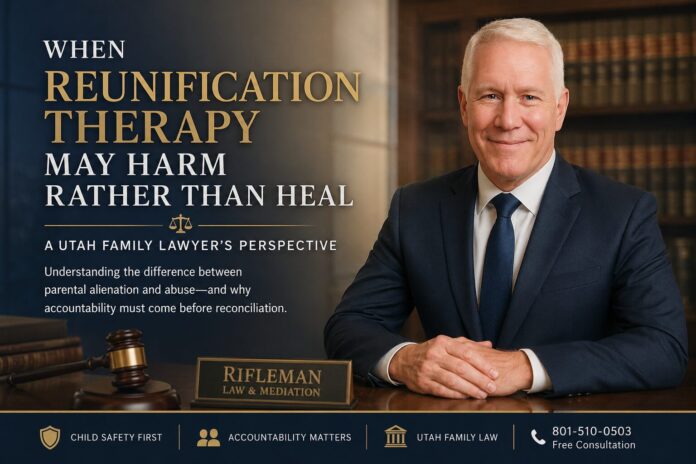
When Reunification Therapy May Harm Rather Than Heal: A Utah Family Lawyer’s Perspective
By Jeff D. Rifleman, Rifleman Law & Mediation
Few subjects in Utah family law generate more controversy than reunification therapy. The very phrase suggests hope—a process designed to restore a fractured relationship between a parent and a child. In many cases, that hope is justified. Children deserve meaningful relationships with both parents whenever those relationships are safe, healthy, and in the child’s best interests.
But there is another side of this discussion that deserves equal attention.
What happens when the child is not estranged because of manipulation, coaching, or parental alienation? What happens when the child’s fear is the product of actual abuse? What happens when the Utah Division of Child and Family Services (DCFS), law enforcement, therapists, or even the court itself concludes that abuse occurred?
At that point, I believe we should ask a difficult question: Is it truly in the child’s best interest to require that child to participate in reunification therapy with the very parent from whom the child needed protection?
As a Utah family law attorney, I believe this question deserves far more discussion than it currently receives.
Reunification Therapy Is Not Inherently Bad
Before going further, let me be clear. I am not opposed to reunification therapy. Quite the opposite. I have represented many parents who were victims of false allegations, malicious gatekeeping, or genuine parental alienation. In those situations, reunification therapy can be an extraordinarily valuable tool. Children deserve the opportunity to rebuild relationships that have been damaged by manipulation or unnecessary conflict. When a loving, capable parent has been unfairly pushed out of a child’s life, reunification therapy may help restore a relationship that never should have been broken. Those cases exist.Unfortunately, they are not every case.
The mistake I sometimes see is assuming that every child who resists contact with a parent is alienated. Sometimes resistance is manipulation. Sometimes resistance is survival from abuse.
There Is a Difference Between Alienation and Protection
One of the most important distinctions in family law is the difference between parental alienation and justified estrangement. A child who refuses to visit a parent because the other parent has manipulated the child presents one set of issues. A child who refuses because that parent physically abused, sexually abused, terrorized, neglected, or psychologically harmed the child presents an entirely different situation.
Those two children may exhibit similar behaviors.
- Both may refuse visits.
- Both may become anxious.
- Both may cry before exchanges.
- Both may say they never want to see the parent again.
The behaviors may look similar. The reasons could not be more different. One child is reacting to manipulation. The other may be reacting to trauma. Treating both children with the same therapeutic model risks causing profound harm.
Utah Law Has Begun to Recognize This Distinction
The Utah Legislature has increasingly emphasized that child safety must remain paramount in custody cases involving abuse allegations.
Utah Code § 81-9-104 specifically addresses expert testimony, findings involving domestic violence or abuse, and reunification treatment. The statute reflects a growing recognition that courts must exercise caution before ordering reunification efforts in cases involving abuse.
Among other protections, the statute provides that where there is reasonable cause to believe domestic violence, child abuse, or an ongoing risk exists, reunification treatment should not be ordered unless there is generally accepted proof that the treatment is physically and psychologically safe, therapeutically effective, and not associated with causing harm to children. It further directs that efforts to address a child’s resistance toward an abusive parent should primarily focus on the abusive parent’s behavior rather than attempting to change the child’s response.
That is an important policy statement.
It recognizes something courts have sometimes struggled with for years:
The solution to abuse is not simply persuading the child to feel differently about the abuse. (That would be like persuading an abused spouse to ignore the domestic abuse, or at least minimize it, and ask the victi to go back to the abuser as if the abuse never occurred or have significant impact on the victim.)
Can Trust Be Ordered?
This raises the question that I believe deserves greater discussion. Can trust actually be ordered by a judge? A court can order parent-time. A court can order counseling. A court can order evaluations. A court can order therapy.
But can any court order a child to trust someone? I do not believe it can. Trust is earned. It cannot be compelled. When trust has been destroyed through abuse, accountability—not judicial compulsion—is what begins the healing process.
An Analogy Worth Considering
This is where I believe family law sometimes finds itself in an uncomfortable position.
Imagine an adult victim of domestic violence. A protective order has been entered. The court has found that abuse occurred. No one would seriously suggest that the victim should immediately begin counseling designed to rebuild emotional intimacy with the abusive spouse simply because marriage vows once promised “until death do us part.” Most people would recognize how inappropriate that would be.
The focus would instead be on safety. On accountability. On whether the abusive spouse has accepted responsibility. On whether meaningful behavioral change has occurred. Only then might reconciliation even become a possibility—and only if the victim freely chose it.
Children, however, rarely possess that same freedom of choice. And, there is currently a push to force reunification at any and all costs.
When the Child Is the Victim
As lawyers, judges, guardians ad litem, therapists, and parents, we often talk about the importance of preserving the parent-child relationship. That principle is deeply rooted in Utah law. Children generally benefit from having meaningful relationships with both parents, and our courts strive to preserve those relationships whenever possible. (The law still has a long way to go to ensure a fair starting point in custody actions with assumptions of 50/50 joint and physical custody.)
But what if the parent-child relationship was not broken by divorce? What if it was broken by abuse? That question changes everything.
When DCFS substantiates abuse, when a juvenile court makes findings of abuse or neglect, or when a district court finds credible evidence that a parent has physically, emotionally, or sexually abused a child, the child’s fear should not automatically be viewed as a problem to solve. Sometimes fear is exactly what keeps children safe.
Trauma is not defiance. A child who recoils from an abusive parent may not be rejecting love. The child may simply be remembering pain.
Who Should Carry the Burden of Repair?
This is where I believe the conversation often becomes backwards.
In many custody disputes, courts understandably focus on restoring the relationship between the child and the rejected parent. That objective may be entirely appropriate when the rejection stems from false allegations, manipulation, or parental alienation.
But if the relationship was damaged because one parent abused the child, why does the therapeutic process sometimes appear to begin with changing the child’s behavior rather than first requiring the offending parent to demonstrate lasting change?
That is not merely a legal question. It is a moral one. The parent who caused the damage should bear the primary responsibility for repairing it. The child should not.
Fortunately, Utah’s Legislature appears to recognize this principle. Utah Code § 81-9-104 now provides that when a court has reasonable cause to believe domestic violence, child abuse, or an ongoing risk exists, any effort to remediate a child’s resistance toward an abusive parent should primarily address the abusive parent’s conduct and contribution to that resistance. The statute also requires courts to prioritize the child’s physical and psychological safety.
That language is significant. It recognizes that the source of the problem matters. However, in practice some overzealous actors still place the ‘reunification aim’ to resestablish the relationship above the child’s safety.
Healing Cannot Be Built Upon Denial
One of the greatest obstacles to meaningful reunification is the refusal of an abusive parent to acknowledge what occurred. If a parent insists that the abuse never happened, blames the child, accuses the other parent of coaching, or portrays himself or herself as the true victim, meaningful reunification becomes extraordinarily difficult.
Children are remarkably perceptive. They know when adults are minimizing their experiences. They know when no one is taking responsibility. Therapy cannot erase that reality. Trust begins with accountability. Without accountability, reunification risks becoming little more than an exercise in asking the child to suppress legitimate feelings in order to satisfy the adults involved in the litigation.
Children Should Not Feel Responsible for Adult Decisions
Children frequently internalize responsibility for circumstances they did not create.
When a court orders reunification therapy after abuse has been substantiated, some children understandably conclude that the adults around them believe they are part of the problem.
That perception can be devastating.
The child may wonder:
- Did no one believe me?
- Was the abuse really that serious?
- Am I expected to pretend everything is normal?
- Am I disappointing the judge if I remain afraid?
Those questions may never be spoken aloud. Yet they can shape a child’s emotional development for years. Courts should be cautious not to unintentionally communicate that a child’s protective instincts are symptoms requiring correction.
The Difference Between Forgiveness and Safety
Our society often celebrates forgiveness. Forgiveness can be healthy. Forgiveness can be freeing. But forgiveness is not the same as trust. Nor is forgiveness the same as safety.
A child may someday forgive an abusive parent while still recognizing that a close relationship is neither safe nor emotionally healthy. Family courts should be careful not to confuse those concepts. The law cannot require forgiveness. More importantly, it should never require a child to ignore legitimate safety concerns in pursuit of an idealized parent-child relationship.
Not Every Broken Relationship Should Be Repaired Immediately
One of the realities lawyers learn over years of practice is that timing matters. Some relationships can be repaired quickly. Others require years of demonstrated change. Some may never be capable of becoming healthy. Judges understandably hope families can heal. Therapists generally believe relationships are worth preserving. Parents often desperately want reconciliation. Those are admirable goals. But hope should never replace evidence.
Before asking a child to participate in rebuilding trust, courts should carefully examine whether the offending parent has accepted responsibility, completed meaningful treatment, demonstrated sustained behavioral change, complied with all recommendations, and shown by actions—not merely words—that the child’s emotional and physical safety comes first.
Absent those factors, reunification risks becoming aspirational rather than therapeutic.
A Better Starting Point
Perhaps the question should not be:
“How do we convince this child to restore the relationship?”
Perhaps the better question is:
“What has the offending parent done to earn the opportunity to rebuild that relationship?”
That subtle shift changes the entire framework. It places responsibility where responsibility belongs. It respects the child’s lived experience. And it remains consistent with Utah’s increasing emphasis on protecting children while requiring courts to carefully evaluate reunification treatment in cases involving abuse.
Protecting Children and Preserving Families Are Not Always the Same Objective
One of the most difficult realities in family law is acknowledging that protecting children and preserving families are not always identical objectives. Most of the time, they are.
Children generally benefit from having healthy, meaningful relationships with both parents. That principle has long been recognized by Utah courts and is reflected throughout Utah’s custody statutes. However, there are cases where those objectives diverge.
When abuse has been substantiated, the primary objective should no longer be restoring a relationship at all costs. The primary objective should be protecting the child while determining whether the offending parent has demonstrated sufficient change to safely earn another opportunity.
That distinction is critical. The law should never assume that every fractured parent-child relationship must immediately be repaired. Some relationships require significant healing before reunification is appropriate. Others may require permanent boundaries to protect the child’s emotional or physical well-being.
The Role of Judges, Guardians ad Litem, and Therapists
Family law professionals face extraordinarily difficult decisions. Judges often have limited time and incomplete information. Guardians ad litem are asked to balance competing narratives while advocating for the child’s best interests. Therapists frequently become involved after significant damage has already occurred. Each professional brings valuable experience to the process. Yet each should remain mindful of one fundamental principle: the presence of a parent-child relationship is not, by itself, evidence that continuing or restoring that relationship is presently in the child’s best interests.
Likewise, a child’s reluctance to engage with a parent should not automatically be interpreted as evidence of parental alienation. Sometimes a child’s resistance reflects manipulation.
Sometimes it reflects trauma. The challenge for every professional involved is to distinguish between those two very different circumstances. That determination requires careful investigation, trauma-informed evaluation, and a willingness to consider objective evidence rather than assumptions.
Every Case Must Be Evaluated Individually
This article should not be interpreted as suggesting that reunification therapy is never appropriate. Far from it. There are many cases in which a child has been improperly influenced to reject a loving parent. In those situations, reunification therapy can provide tremendous benefits and may restore a relationship that should never have been interrupted.
Likewise, there are situations in which a parent who once engaged in abusive or harmful conduct has accepted responsibility, completed treatment, demonstrated meaningful behavioral change over an extended period of time, and genuinely earned the opportunity to rebuild trust. Those cases exist as well.
The point is not that reunification therapy should never occur. The point is that courts should carefully distinguish between children who are alienated from a safe parent and children who are protecting themselves from an unsafe one. Those are fundamentally different cases requiring fundamentally different approaches.
A Question Worth Asking
As our understanding of childhood trauma continues to evolve, perhaps family courts should ask a different question before ordering reunification therapy:
Has the parent seeking reunification demonstrated, through consistent actions rather than promises, that rebuilding this relationship is presently safe for the child?
If the answer is yes, reunification therapy may become a valuable part of that process.
If the answer is no, compelling the child to participate may unintentionally shift responsibility away from the adult whose conduct created the problem in the first place. Children should never be expected to carry that burden.
Final Thoughts
Family courts perform one of the most difficult functions in our justice system. Judges make life-changing decisions based upon imperfect information, often while trying to balance competing constitutional rights, parental interests, and the welfare of children. Reasonable people can disagree about where that balance should be struck.
My concern is not with reunification therapy as a concept. It is with ensuring that the therapy is used for the right reasons, in the right cases, and at the right time.
When abuse has been substantiated, the first priority should be accountability, demonstrated change, and child safety. Rebuilding trust should be the product of those efforts—not the starting point. Trust cannot be ordered. Relationships cannot be legislated. And children should never feel responsible for repairing damage they did not cause.
Need Advice About a Utah Child Custody or Reunification Therapy Case?
Custody disputes involving allegations of abuse, parental alienation, reunification therapy, or DCFS investigations require careful legal analysis. Every case is unique, and outcomes depend upon the specific facts, the applicable law, and the evidence presented to the court.
If you are facing a custody dispute involving reunification therapy or allegations of abuse, understanding your rights under Utah law is essential.
Learn more about our child custody resources:
- Utah Child Custody & Parent-Time
- Saratoga Springs Child Custody Lawyer
- Lehi Child Custody Lawyer
- American Fork Child Custody Lawyer
- Eagle Mountain Child Custody Lawyer
- Utah Divorce Resources
Disclaimer: This article reflects the author’s opinions regarding public policy and family law practice. It is intended for educational purposes only and is not legal advice. Every custody case presents unique facts and legal issues that should be evaluated individually.
